


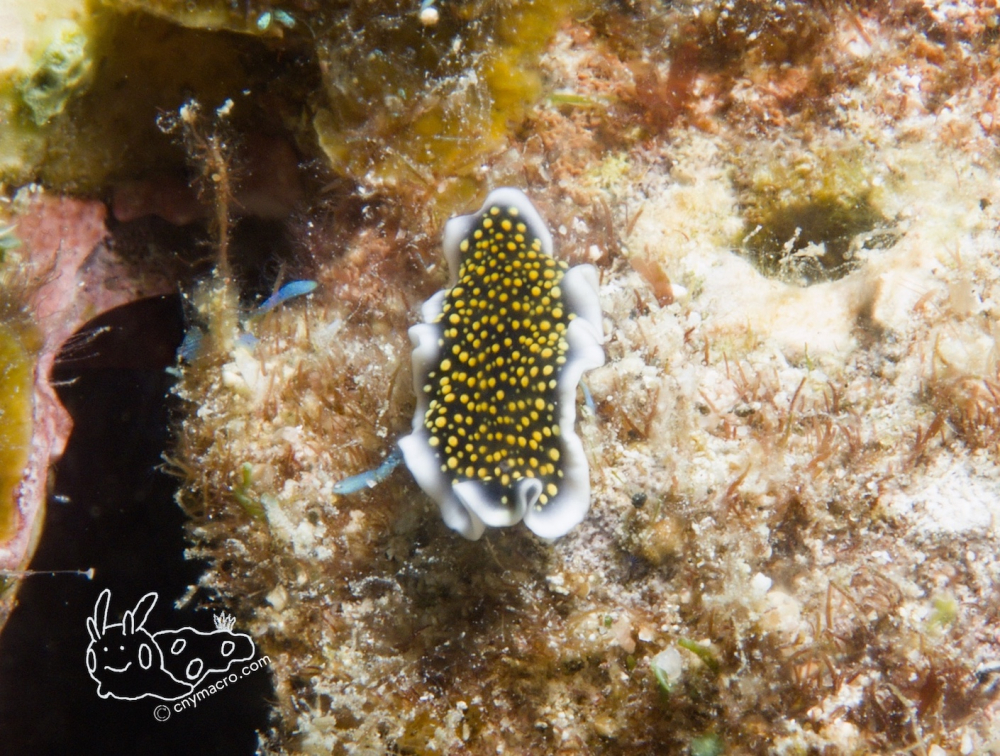
Scientific name: Thysanozoon nigropapillosum sp.
Identification: Thysanozoon nigropapillosum is one of the reef's most recognizable flatworms. Its long, broad body is a deep, velvety black, densely covered in short papillae tipped with vivid orange — creating a dazzling starry-night effect that gives it its French name, Ver plat ciel étoilé. The outer margin of the body is bordered in opaque white, adding a crisp contrasting edge to its undulating silhouette. The ventral surface is dark brown. Two small, ear-like pseudotentacles are visible at the anterior end. When it moves, it glides with a fluid, rippling grace — and when truly motivated, it can actually swim, propelling itself through the water with a mesmerizing rhythmic undulation of its entire body.
Size: Up to 76 mm in length.
Habitat: Common along external reef slopes, coral heads, reef walls, and rubble zones throughout the tropical Indo-Pacific. Frequently observed in the shallow subtidal zone, in well-lit areas where its striking coloration is most visible.
Depth Range: 1 – 20 meters.
Diet: Carnivorous; feeds primarily on tunicates, engulfing colonial Didemnum spp. with its large, eversible pharynx. After digestion, it regurgitates compact food pellets containing the calcareous spicules from its prey's tunic — a fascinating trace of its meal left behind on the reef.
Reproduction: A simultaneous hermaphrodite, like all polyclad flatworms, Thysanozoon nigropapillosum engages in penis fencing — two individuals duel to inseminate each other. The one that gets inseminated becomes the egg-layer!
Fun Fact: A living piece of the night sky drifting across the reef — but also a surprisingly bold swimmer. When threatened or simply on the move, this flatworm lifts off the substrate and undulates through the water column with elegant, wave-like contractions. Not bad for an animal with no brain, no bones, and no shell